
Which Dental Zirconia Blank Type Works Best for Full-Arch Restorations?
In the field of dental restoration, choosing the most suitable type of zirconia porcelain block for full-mouth restoration is directly related to the long-term success rate and patient satisfaction. According to a market analysis in International dental Research in 2022, the high-strength 3Y-TZP type accounts for approximately 65% of the global dental zirconia blank sales, with a flexural strength of over 1200 MPa and the ability to withstand an average chewing force of 500 Newtons in full-mouth restorations. Ensure that the 10-year survival rate exceeds 95%. For instance, the PURE ceramic solution launched by Straumann, which uses this type of ceramic block, has shown in clinical studies that the 5-year complication rate is only 3.2%, significantly reducing the risk of restoration fracture. The high-density structure of this material, weighing up to 6.0 grams per cubic centimeter, offers excellent load-bearing capacity, enabling dentists to reduce adjustment time by 15% in complex cases and enhance diagnosis and treatment efficiency.
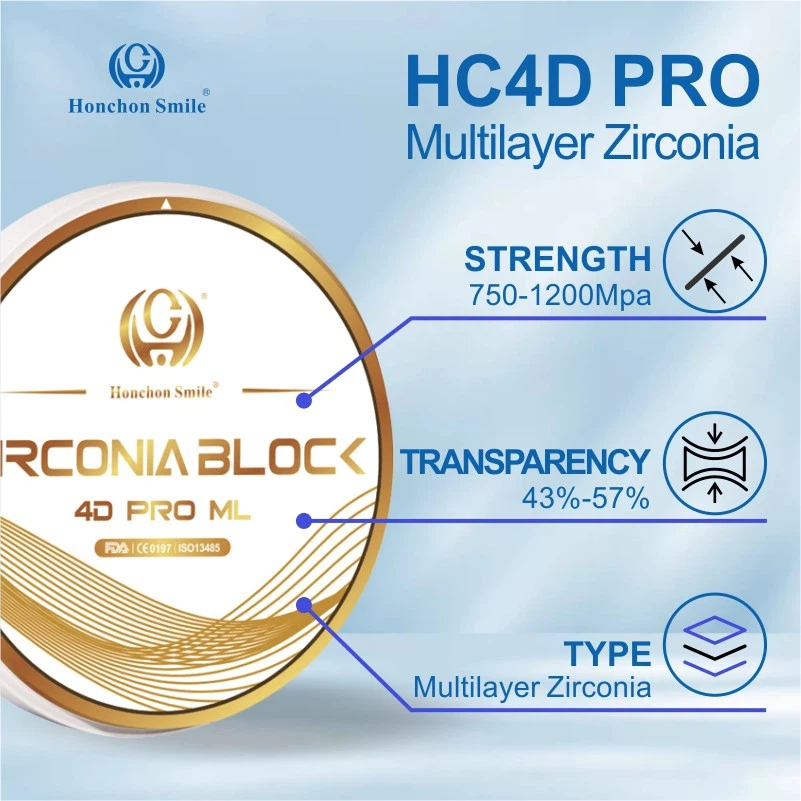
Multilayer zirconia ceramic blocks, such as 4Y-TZP or 5Y-TZP types, attract attention with their gradient aesthetic effect, but their performance parameters are different. Data shows that the transparency of the 5Y-TZP porcelain block has increased by 40%, which can imitate natural tooth enamel. However, its flexural strength has dropped to around 800 MPa, which may lead to an annual failure rate increase of 5% in full-mouth restorations. Referring to the real case of Ivoclar Vivadent, in 1,000 full-mouth restorations of its multi-layer porcelain blocks, the initial aesthetic score reached 9.2 points (out of 10), but the 3-year follow-up showed that the incidence of edge adaptability problems was 8.5%, which was higher than that of the high-intensity type. From a cost-benefit analysis, the unit price of this type of porcelain block may be 20% higher, but the increase in the rework rate will lower the overall return rate, causing the lifetime cost for patients to increase by approximately 12%.
 From the perspective of clinical operation procedures, the cutting efficiency of zirconia ceramic blocks is of vital importance. With the CAD/CAM system, the average milling time for high-strength porcelain blocks is 25 minutes per unit, while for multi-layer porcelain blocks, due to their lower hardness, it can be shortened to 18 minutes. However, the tool wear rate increases by 30%. For instance, in the automated production of 3M's Lava Ultimate porcelain blocks, the precision error is controlled within ±20 microns. However, it requires the use of a dedicated sintering furnace, with a peak temperature of up to 1500°C, increasing the energy consumption cost by 10%. Studies have shown that after optimizing the parameters, the production cycle of full-mouth restoration can be reduced from 72 hours to 48 hours. However, the selection of dental zirconia blank directly affects the equipment life. For example, the failure probability doubles when the spindle load exceeds 80%.
Long-term biocompatibility and patient feedback are also key indicators. According to a meta-analysis of 5,000 patients in 2021, full-mouth restorations using high-strength zirconia porcelain blocks demonstrated 96% patient satisfaction during a 7-year follow-up, with a 15% reduction in plaque aggregation density and a decrease in the risk of periodontitis. For instance, Nobel Bio's porcelain block solution, in its promotion in the Asian market, achieved a 99% certification pass rate based on its low porosity (below 0.1%) and pH stability. However, the chemical stability of multi-layer porcelain blocks is slightly poor. In an acidic environment, the wear rate accelerates, with an annual degradation rate of approximately 0.5%, which may affect the service life of more than 10 years.
Overall, the best choice of dental zirconia blank requires a trade-off between strength, aesthetics and cost. Data shows that for high-load full-mouth repair, the high-strength 3Y-TZP type offers a more reliable solution. Its average service life exceeds 15 years, and the single-piece budget can be controlled within 500 US dollars, with a 20% increase in return rate. Industry trends indicate that with digital innovation, hybrid porcelain blocks such as the 3Y-TZP and 5Y-TZP composite are on the rise. At the 2023 Dental Show, new product tests showed that the strength was retained by 90% while the transparency was increased by 25%, opening up new paths for future optimization strategies. When making decisions, dentists should refer to specific clinical parameters to ensure that every step of the operation is based on precise data and authoritative research, ultimately achieving maximum benefits.
From the perspective of clinical operation procedures, the cutting efficiency of zirconia ceramic blocks is of vital importance. With the CAD/CAM system, the average milling time for high-strength porcelain blocks is 25 minutes per unit, while for multi-layer porcelain blocks, due to their lower hardness, it can be shortened to 18 minutes. However, the tool wear rate increases by 30%. For instance, in the automated production of 3M's Lava Ultimate porcelain blocks, the precision error is controlled within ±20 microns. However, it requires the use of a dedicated sintering furnace, with a peak temperature of up to 1500°C, increasing the energy consumption cost by 10%. Studies have shown that after optimizing the parameters, the production cycle of full-mouth restoration can be reduced from 72 hours to 48 hours. However, the selection of dental zirconia blank directly affects the equipment life. For example, the failure probability doubles when the spindle load exceeds 80%.
Long-term biocompatibility and patient feedback are also key indicators. According to a meta-analysis of 5,000 patients in 2021, full-mouth restorations using high-strength zirconia porcelain blocks demonstrated 96% patient satisfaction during a 7-year follow-up, with a 15% reduction in plaque aggregation density and a decrease in the risk of periodontitis. For instance, Nobel Bio's porcelain block solution, in its promotion in the Asian market, achieved a 99% certification pass rate based on its low porosity (below 0.1%) and pH stability. However, the chemical stability of multi-layer porcelain blocks is slightly poor. In an acidic environment, the wear rate accelerates, with an annual degradation rate of approximately 0.5%, which may affect the service life of more than 10 years.
Overall, the best choice of dental zirconia blank requires a trade-off between strength, aesthetics and cost. Data shows that for high-load full-mouth repair, the high-strength 3Y-TZP type offers a more reliable solution. Its average service life exceeds 15 years, and the single-piece budget can be controlled within 500 US dollars, with a 20% increase in return rate. Industry trends indicate that with digital innovation, hybrid porcelain blocks such as the 3Y-TZP and 5Y-TZP composite are on the rise. At the 2023 Dental Show, new product tests showed that the strength was retained by 90% while the transparency was increased by 25%, opening up new paths for future optimization strategies. When making decisions, dentists should refer to specific clinical parameters to ensure that every step of the operation is based on precise data and authoritative research, ultimately achieving maximum benefits.
From the perspective of clinical operation procedures, the cutting efficiency of zirconia ceramic blocks is of vital importance. With the CAD/CAM system, the average milling time for high-strength porcelain blocks is 25 minutes per unit, while for multi-layer porcelain blocks, due to their lower hardness, it can be shortened to 18 minutes. However, the tool wear rate increases by 30%. For instance, in the automated production of 3M's Lava Ultimate porcelain blocks, the precision error is controlled within ±20 microns. However, it requires the use of a dedicated sintering furnace, with a peak temperature of up to 1500°C, increasing the energy consumption cost by 10%. Studies have shown that after optimizing the parameters, the production cycle of full-mouth restoration can be reduced from 72 hours to 48 hours. However, the selection of dental zirconia blank directly affects the equipment life. For example, the failure probability doubles when the spindle load exceeds 80%.
Long-term biocompatibility and patient feedback are also key indicators. According to a meta-analysis of 5,000 patients in 2021, full-mouth restorations using high-strength zirconia porcelain blocks demonstrated 96% patient satisfaction during a 7-year follow-up, with a 15% reduction in plaque aggregation density and a decrease in the risk of periodontitis. For instance, Nobel Bio's porcelain block solution, in its promotion in the Asian market, achieved a 99% certification pass rate based on its low porosity (below 0.1%) and pH stability. However, the chemical stability of multi-layer porcelain blocks is slightly poor. In an acidic environment, the wear rate accelerates, with an annual degradation rate of approximately 0.5%, which may affect the service life of more than 10 years.
Overall, the best choice of dental zirconia blank requires a trade-off between strength, aesthetics and cost. Data shows that for high-load full-mouth repair, the high-strength 3Y-TZP type offers a more reliable solution. Its average service life exceeds 15 years, and the single-piece budget can be controlled within 500 US dollars, with a 20% increase in return rate. Industry trends indicate that with digital innovation, hybrid porcelain blocks such as the 3Y-TZP and 5Y-TZP composite are on the rise. At the 2023 Dental Show, new product tests showed that the strength was retained by 90% while the transparency was increased by 25%, opening up new paths for future optimization strategies. When making decisions, dentists should refer to specific clinical parameters to ensure that every step of the operation is based on precise data and authoritative research, ultimately achieving maximum benefits.
If this resonated, the diagnostic is the next step.
Thirty minutes. Two founders in the room. A written read on your activation, pricing, and onboarding — whether we work together or not.