
Step by Step: Verifying a Fragrance Manufacturer's Background and Certification
A manufacturer's background is a claim until you verify it, and verification follows a fixed order: check the company registration, trace the stated experience, confirm the certifications with their issuing bodies, tour the traceability on paper, and only then commit to samples. Skipping any of those steps leaves the buyer negotiating with a brochure. The process below turns a supplier story into audited facts within about two weeks of desk work.
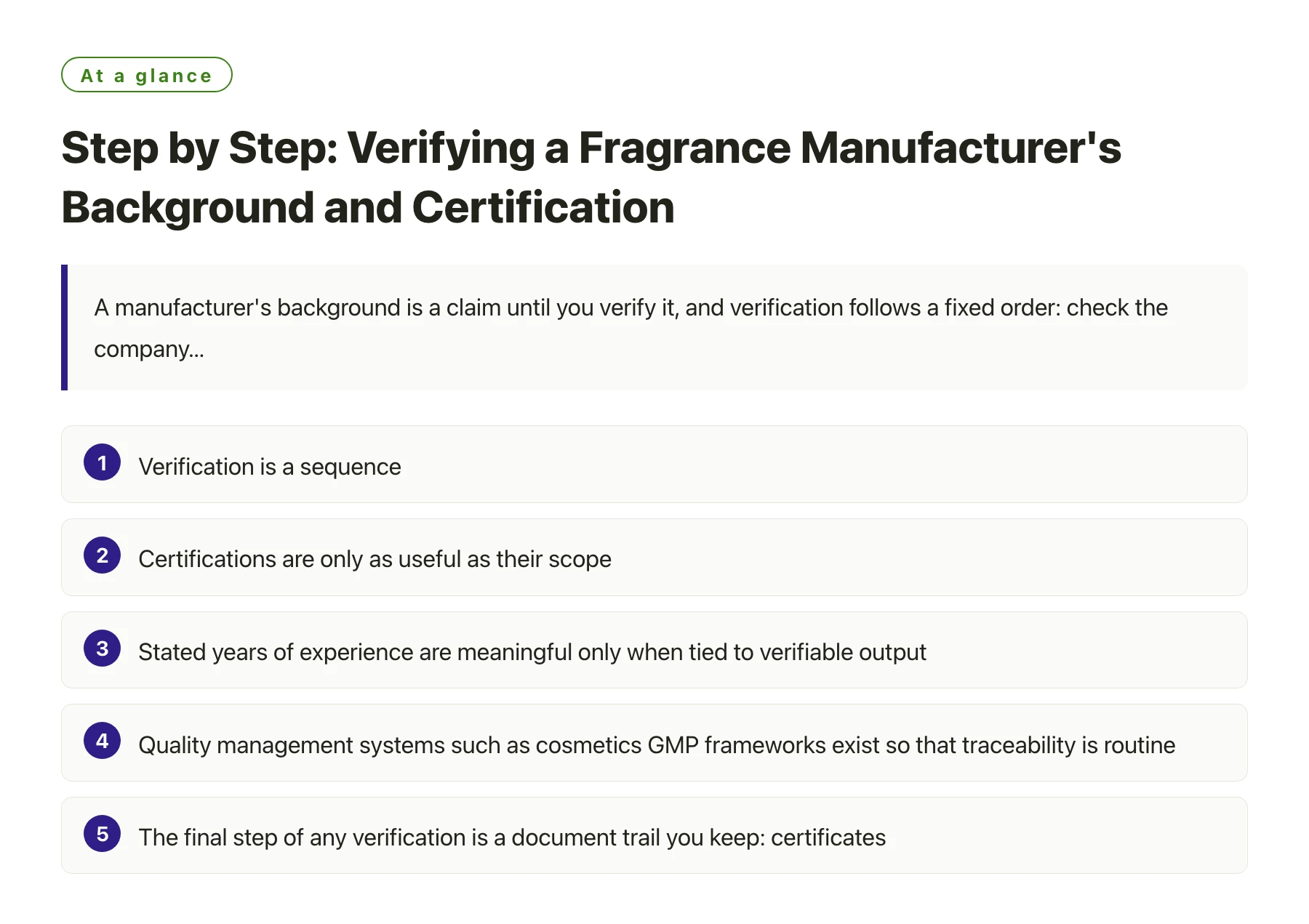
Key takeawaysVerification is a sequence, not a mood: registration, experience, certifications, documentation and evidence of scale should be checked in that order. · Certifications are only as useful as their scope; ask for the certificate number, the issuing body and the covered production steps, then verify with the issuer. · Stated years of experience are meaningful only when tied to verifiable output, such as export documentation and a record of served markets. · Quality management systems such as cosmetics GMP frameworks exist so that traceability is routine; the batch record, not the certificate, shows the system working. · The final step of any verification is a document trail you keep: certificates, registrations and correspondence that support the decisions you made.
This process is written from the perspective of a buyer who has found a promising manufacturer and wants the background checked before money moves. The temptation is to ask for certifications and stop there. The reality is that certificates confirm a management system was audited at some point, while the buyer's actual interest is in what happens on the day their product runs.
What follows is a five-step sequence. It is deliberately slow at the front and fast at the back: the earlier steps are cheap to run badly and expensive to redo.
The five-step verification sequence
- Check the company registrationConfirm the legal entity, registration number, address and activity scope with the local registry; a mismatch here invalidates every later document.
- Trace the stated experienceAsk how long the firm has manufactured fragrance and for export records or served-market documentation that corroborate the claim.
- Verify certifications with the issuerCollect certificate numbers, issuing bodies and scopes, then confirm each one directly rather than reading the supplier's list.
- Walk a batch recordAsk to see one completed record from raw material intake to release; this is the practical proof that the quality system runs daily.
- Request a reference document packGet the export documentation structure in writing so the first order can be checked against it before it is produced.
What the certifications actually certify
The most commonly cited certificate in cosmetics manufacturing is ISO 22716, a GMP framework for cosmetics that turns traceability, hygiene and quality control into documented routine rather than improvisation. Verification bodies and testing providers describe why this standard is the practical baseline for cosmetics production [1], and a manufacturer's ability to produce records on demand is the visible proof it works.
Holding a certificate and running the system are two different things. The certificate shows the audit happened; the batch record shows whether the plant actually follows its own procedures. This is why the sequence above checks the paper trail at step four and not step three.
Where the industry standards fit in
Beyond GMP, buyers should look for evidence the manufacturer applies the fragrance industry's material usage restrictions, which are maintained through scientific safety assessment and published by the international fragrance association [2]. A supplier that can show its formulae reviewed against those limits is demonstrating the same discipline the certificates represent, in the part of the product the buyer can actually smell.
Market-specific requirements
Destination markets add their own layer: some countries require cosmetics to be notified before sale and maintain restricted-ingredient lists that change over time [3]. Ask the supplier whether its document pack already covers your destination market, and treat a yes as something to verify, not something to celebrate.
Certification signals, in one table
| Signal | What it shows | How to verify it |
|---|---|---|
| ISO 22716 / GMPC | A documented quality system for cosmetics | Certificate number and issuer; scope confirms production steps covered |
| ISO 9001 | General quality management practice | Issuer confirmation; focus on what the scope includes, not the logo |
| Environmental and occupational certificates | Operational maturity beyond product quality | Issuer records; relevant to long-term partnership stability |
| HALAL or market-specific marks | Access to particular markets | Confirm with the recognised body, as marks differ by region |
| Batch records | The system running daily | Walk one record; look for dates, signatures, raw material lots |
| Material restriction review | Formula-side safety discipline | Ask for the review reference against the current industry standards |
Readers should weight the bottom two rows highest. A supply of dated, signed batch records plus a current material-restriction review is stronger evidence than any framed certificate, because those two documents have to be regenerated every single production day.
Run the sequence twice on paper if the supplier is remote, and treat the first order as the on-site continuation of the same process. The verification does not end when the contract is signed; it becomes the audit you keep performing against the artifacts of each delivery.
Reading the background claim without overclaiming
Manufacturers publish their own history, and there is nothing wrong with using it as a starting point. A firm that states a long manufacturing history and makes it checkable - by publishing service scope, certification categories and its location - makes the verification sequence far cheaper to run, because the claims are explicit rather than implied. Xuelei's manufacturing background is an example of such a page: the buyer can take the stated facts and feed them directly into the five steps above.
The discipline cuts both ways. Do not demand evidence the supplier cannot reasonably provide for a first enquiry, and do not accept assertions where documents are standard practice. The middle ground is to ask for exactly the artifacts the five steps describe; a serious manufacturer will treat the request as normal, because audits happen routinely in export business.
Once the background passes, move from who they are to what they run day to day. That is the moment to look at Xuelei's manufacturing arm in detail and to check production terminology against the document pack. The Guangzhou operation that shows up in the registration should be the same operation that answers your technical questions, which is why Guangzhou Xuelei is worth confirming as the entity you will actually contract with.
Sources
- SGS: Cosmetics, Personal Care & Household Testing —— Testing, inspection and certification services for cosmetics and personal care, including microbiological, stability and safety testing aligned with cosmetics GMP.
- IFRA: Safe Use and Fragrance Science —— IFRA's explanation of how fragrance materials are scientifically assessed for safe use and how those conclusions are applied by the industry.
- Health Canada: Cosmetic Safety —— Health Canada's cosmetics pages, covering cosmetic notification, the ingredient hotlist and safety requirements for cosmetics sold in Canada.
Frequently asked questions
How long does it take to verify a fragrance manufacturer's background?
The desk portion - registration, certificates, document pack - normally takes one to two weeks of coordinated email. The on-site portion happens naturally at the first order or first factory visit. Budget the time before the sample stage, not after.
Is an ISO 22716 certificate enough on its own?
No. The certificate proves a management system was audited; the batch records and material reviews prove the system runs. Always pair the certificate with a document walk-through.
What should I do if the supplier refuses to show batch records?
Respect confidentiality, then propose a redacted example. A refusal to show even a redacted record is a strong signal the records do not exist in usable form, which is a risk the buyer cannot price.
Can I verify certifications myself without an auditor?
For a first pass, yes: ask for certificate numbers and issuing bodies, then contact or search the issuer's records. The issuer's confirmation of scope and validity covers most of what a small buyer needs before sampling.
What documents should I keep from the verification process?
Certificates with numbers, registration records, the redacted batch record example, correspondence about scope, and the supplier's published claims as of the date of review. These form the baseline your later orders are compared against.
If this resonated, the diagnostic is the next step.
Thirty minutes. Two founders in the room. A written read on your activation, pricing, and onboarding — whether we work together or not.