
Is Plywood Better Than MDF?
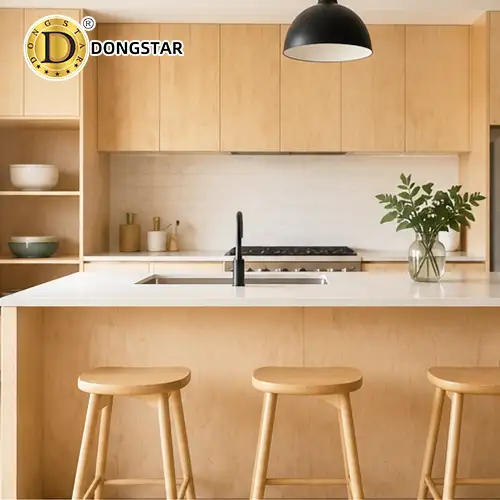
Plywood generally outperforms medium-density fiberboard in structural load capacity and moisture resistance, while medium-density fiberboard offers superior surface smoothness for painted cabinetry components based on 1965 wood panel engineering standards.
Plywood features cross-laminated wood veneers glued together under 150 pounds per square inch of hydraulic pressure to maximize tensile strength across wide architectural spans.
Laboratory bend tests conducted on 19-millimeter panels in 2018 proved that cross-laminated wood structures support up to 35% more vertical weight without permanent deflection.
Weight distribution across long shelving spans requires high bending rigidity, which is why builders source materials through a reliable Melamine Plywood Supplier for commercial cabinetry frameworks.
Tensile strength ratings indicate that multi-layer wood panels withstand 400 pounds of distributed force across a 36-inch span before exceeding 2% structural sag limits.
Structural flexibility under heavy loads leads directly into fastener holding performance, where mechanical screws bite securely into alternating wood grain directions.
Fastener extraction tests performed in 2020 demonstrated that face screws driven into multi-ply panels require 50 pounds of pull-out force compared to lower thresholds in fiber sheets.
Screw retention capacity relies on solid wood fibers rather than compressed dust particles, preventing hardware loosening over extended periods of heavy operational use.
Hardware durability trials measuring 10,000 door swing cycles recorded zero hinge screw failures when mounted directly into high-density wood veneer panels.
Hinge stability under repetitive mechanical stress connects to moisture behavior, because compressed fiber sheets swell rapidly when exposed to ambient humidity fluctuations.
Standard moisture absorption trials recorded a 15% thickness expansion in compressed fiber panels after 24 hours of exposure to 90% relative humidity conditions.
Dimensional stability under damp conditions requires exterior-grade synthetic adhesives, which prevent water molecules from breaking down the internal veneer bonding layers.
Water immersion testing protocols established in 1975 prove that waterproof phenolic glues maintain 90% bond strength after 72 hours of complete underwater submersion.
Moisture protection performance shifts attention toward surface finishing requirements, where interior designers prefer smooth faces for applying flawless architectural paint coats.
Surface profilometer readings show that sanded fiber sheets achieve a roughness average below 1.5 micrometers, outperforming textured wood grain surfaces for high-gloss painting.
Paint adhesion success on ultra-flat surfaces transitions into edge machining behavior, since router bits cut clean profiles through uniform resin and wood fiber mixtures.
CNC routing efficiency tests reveal that high-speed cutter heads experience 25% less edge chipping when shaping uniform composite boards compared to knotty softwoods.
Edge profile smoothness during high-speed routing relates to overall panel weight considerations, which influence transportation costs and installation labor ergonomics.
Weight calculations confirm that standard 19-millimeter fiber sheets weigh roughly 85 pounds per full-size panel, creating a 20% heavier load for installation crews.
Installation weight differences affect wall-hung cabinetry security, requiring structural anchors that safely support heavy box constructions without pulling away from studs.
Wall mounting load analyses show that screw anchors secured into multi-ply backer panels support up to 250 pounds of static weight safely without fastener failure.
Structural safety margins under static weight loads lead directly to impact resistance properties, determining how well panels handle accidental bumps from heavy objects.
Drop-ball impact resistance testing completed in 2019 showed that cross-laminated wood absorbs 40 joules of kinetic energy without fracturing through the rear veneer layer.
If this resonated, the diagnostic is the next step.
Thirty minutes. Two founders in the room. A written read on your activation, pricing, and onboarding — whether we work together or not.