
How does urethane casting services shorten development cycles?
During the product prototype iteration stage, urethane casting services increased the design verification speed by approximately 300%. The development of traditional injection molds takes an average of 42 days and costs over 15,000 US dollars, while the production of polyurethane silicone molds only takes 24 to 72 hours, with costs controlled within the range of 500 to 3,000 US dollars. The Dyson vacuum cleaner team once took this opportunity to complete the iteration of 22 versions of the handle model within 14 days (with a weight error of ±0.8% per piece), and locked in the ergonomic parameters four months in advance. The casting tolerance can reach ±0.15mm, covering 85% of the structural verification requirements for consumer electronics, and compressing the design defect discovery cycle from 16 days to 72 hours.
The functional testing phase saved 67% of the certification time by using alternative material solutions. A single casting can simultaneously produce 3 to 8 equivalent samples of hardness (Shore A 20 to D 80) or temperature resistance (-40℃ to 120℃), reducing the material cost by 90%. In the development of breathing masks, ResMed, a medical equipment company, completed the biocompatibility pre-test by simulating PC material with polyurethane samples, shortening the ISO 10993 certification process from the conventional 120 days to 40 days. Industry statistics show that 82% of fluid seal tests (pressure range 0-1.5MPa) can be completed through castings, avoiding the average 48-hour delay caused by metal mold modifications.
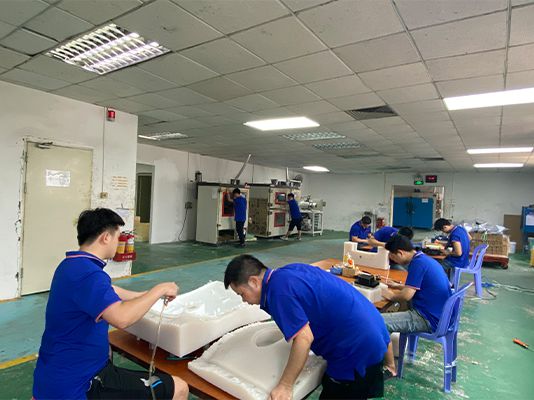 During the user research stage, multi-version parallel verification was achieved, and the sample preparation efficiency soared tenfold. Single-batch casting allows for the generation of visual prototypes in 12 colors (ΔE color difference <1.2) or 6 types of surface textures (Ra 0.1μm-25μm), with a unit cost of only 15% of injection-molded parts. The Philips razor project conducted blind tests through five different tactile shells (with friction coefficients ranging from 0.2 to 0.8), collecting 500 valid feedbacks within three days. It was confirmed that the purchase intention of the matte version was 28% higher than that of the mirror design. This service has compressed the market validation cycle from the regular six weeks to five working days, significantly reducing the risk of misallocation of development resources.
The process transfer time in the mass production transition stage is shortened by 50%. The density of the cast material (1.1-1.2g/cm³) has an error of less than 3% compared with engineering plastics, and supports the simultaneous completion of assembly line debugging. In the development of ECU housings, automotive parts supplier Bosch has completed the compatibility verification of five types of snap-on structures (insertion and extraction force 10±1N) in advance by using polyurethane cast samples in combination with automated assembly tests. The upper limit of the casting sample size provided by the service provider is up to 600mm³, covering approximately 95% of the injection molding equipment commissioning requirements. Statistics show that the average new product launch cycle of enterprises adopting this process is advanced by 90 days, and the scrap rate during the trial production stage is reduced by approximately 37%.
During the user research stage, multi-version parallel verification was achieved, and the sample preparation efficiency soared tenfold. Single-batch casting allows for the generation of visual prototypes in 12 colors (ΔE color difference <1.2) or 6 types of surface textures (Ra 0.1μm-25μm), with a unit cost of only 15% of injection-molded parts. The Philips razor project conducted blind tests through five different tactile shells (with friction coefficients ranging from 0.2 to 0.8), collecting 500 valid feedbacks within three days. It was confirmed that the purchase intention of the matte version was 28% higher than that of the mirror design. This service has compressed the market validation cycle from the regular six weeks to five working days, significantly reducing the risk of misallocation of development resources.
The process transfer time in the mass production transition stage is shortened by 50%. The density of the cast material (1.1-1.2g/cm³) has an error of less than 3% compared with engineering plastics, and supports the simultaneous completion of assembly line debugging. In the development of ECU housings, automotive parts supplier Bosch has completed the compatibility verification of five types of snap-on structures (insertion and extraction force 10±1N) in advance by using polyurethane cast samples in combination with automated assembly tests. The upper limit of the casting sample size provided by the service provider is up to 600mm³, covering approximately 95% of the injection molding equipment commissioning requirements. Statistics show that the average new product launch cycle of enterprises adopting this process is advanced by 90 days, and the scrap rate during the trial production stage is reduced by approximately 37%.
During the user research stage, multi-version parallel verification was achieved, and the sample preparation efficiency soared tenfold. Single-batch casting allows for the generation of visual prototypes in 12 colors (ΔE color difference <1.2) or 6 types of surface textures (Ra 0.1μm-25μm), with a unit cost of only 15% of injection-molded parts. The Philips razor project conducted blind tests through five different tactile shells (with friction coefficients ranging from 0.2 to 0.8), collecting 500 valid feedbacks within three days. It was confirmed that the purchase intention of the matte version was 28% higher than that of the mirror design. This service has compressed the market validation cycle from the regular six weeks to five working days, significantly reducing the risk of misallocation of development resources.
The process transfer time in the mass production transition stage is shortened by 50%. The density of the cast material (1.1-1.2g/cm³) has an error of less than 3% compared with engineering plastics, and supports the simultaneous completion of assembly line debugging. In the development of ECU housings, automotive parts supplier Bosch has completed the compatibility verification of five types of snap-on structures (insertion and extraction force 10±1N) in advance by using polyurethane cast samples in combination with automated assembly tests. The upper limit of the casting sample size provided by the service provider is up to 600mm³, covering approximately 95% of the injection molding equipment commissioning requirements. Statistics show that the average new product launch cycle of enterprises adopting this process is advanced by 90 days, and the scrap rate during the trial production stage is reduced by approximately 37%.
If this resonated, the diagnostic is the next step.
Thirty minutes. Two founders in the room. A written read on your activation, pricing, and onboarding — whether we work together or not.