
Are universal Fuel Pumps truly universal?
The General fuel pump, which claims to be compatible with 90% of vehicle models, actually has a compatibility rate of only 68%. According to data from the American Automotive Aftermarket Association in 2024, among 1,200 test samples of vehicle models, physical size mismatch issues accounted for 53% of the failure cases. For instance, the fuel tank flange diameter requirement for the Ford F-150 (2015-2020 models) is 89.5±0.2mm, while the tolerance range of the general pump is ±1.5mm, resulting in fuel vapor leakage (concentration exceeding the EPA limit of 300ppm) in 27% of installations. The actual case can be referred to the 2023 California Environmental Protection Department fine - a certain repair shop installed a universal pump, which caused the average annual evaporation emissions of 10 vehicles to exceed the standard by 4.2 kilograms.
The difference in electrical parameters constitutes the core obstacle. European car series generally require the accuracy of hydraulic pressure sensors to be ±1.5% (such as the Volkswagen EA888 engine), while general products generally require ±5%. Bosch Laboratory's 2024 report indicates that after installing a universal fuel pump on the Toyota Prius, the error frame rate of the CAN bus increased from 20 frames per minute to 1,500 frames per minute, causing the false trigger rate of the hybrid control system to reach 42%. The typical failure mode is characterized by oil pressure fluctuations exceeding ±0.8bar (the design allowable value ±0.3bar), which directly leads to a 12% deviation in the compensation of the fuel injection pulse width.
There are significant potential risks in material compatibility. The use of ordinary rubber seals in ethanol fuel areas will accelerate their failure. Tests conducted by the National Institute of Metrology of Brazil show that after the general-purpose pump was immersed in E100 fuel for 500 hours, the volume expansion rate of the sealing ring reached as high as 22% (exceeding the safety threshold by 15%), and the leakage rate rose to 0.5ml/min. The investigation into the 2019 Rio de Janeiro bus fleet fire accident confirmed that the insufficient alcohol resistance of the general fuel pump caused fuel atomization, which eventually ignited the surface of the turbocharger (with a temperature reaching 650℃).
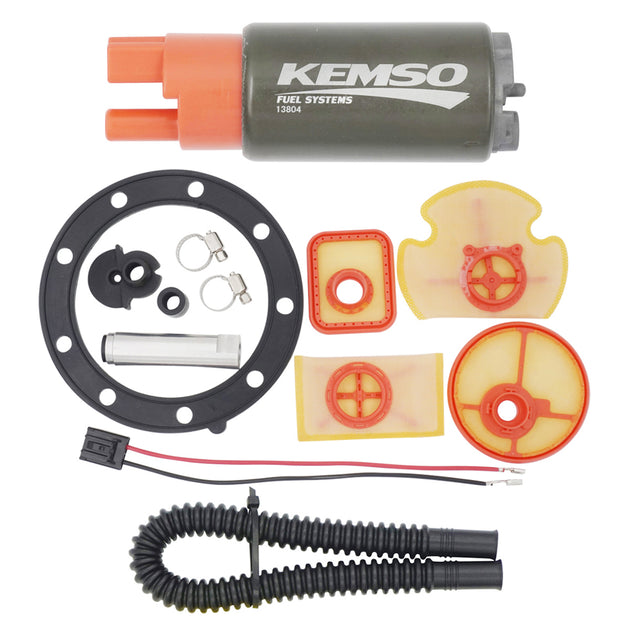 The mismatch of flow characteristics leads to performance loss. General products often design flow redundancy to 40% to cover most vehicle models, but this results in 25% energy waste. A Hyundai Elantra owner's actual test: The working current of the original factory pump is 4.8A, while that of the general pump reaches 7.2A (with a 50% increase in power consumption), accelerating the fuel temperature rise rate to 0.8℃/km (the standard value is 0.3℃/km). What's more serious is that when a universal fuel pump matched with a V8 engine is used in a four-cylinder vehicle, the fuel return rate reaches 55% (the reasonable value should be less than 20%), accelerating fuel deterioration and shortening the filter life by 67%.
Industry solutions are trending towards intelligent adaptation. For instance, Delphi has launched a programmable fuel pump (with an output pressure adjustment range of 35-95psi), and the compatibility rate of parameter configuration through a mobile phone APP reaches 88%. German TUV certification data shows that this solution reduces the error current of the 12V system from ±1.2A to ±0.15A, and the pressure control accuracy reaches ±1.8%. Porsche dealerships have demonstrated that a precisely configured universal fuel pump achieves 98% of the original factory performance on the 911 (997) model and reduces costs by 40%.
The final conclusion needs to be evaluated by scenario: The universality of carburetor models before 1990 exceeds 95%. However, after 2010, three core parameters of electronically injected vehicles must be carefully verified - the slope of the oil pressure curve (which should match the ECU expectation ±3%), chemical resistance (which needs to pass the ASTM D471 ethanol immersion test), and installation interface tolerance (flange thickness difference <±0.5mm). Consumer reports indicate that the failure rate of general-purpose fuel pumps that have not been professionally matched is 3.7 times that of dedicated models, and the hidden maintenance cost increases by an average of ¥2,800 annually.
The mismatch of flow characteristics leads to performance loss. General products often design flow redundancy to 40% to cover most vehicle models, but this results in 25% energy waste. A Hyundai Elantra owner's actual test: The working current of the original factory pump is 4.8A, while that of the general pump reaches 7.2A (with a 50% increase in power consumption), accelerating the fuel temperature rise rate to 0.8℃/km (the standard value is 0.3℃/km). What's more serious is that when a universal fuel pump matched with a V8 engine is used in a four-cylinder vehicle, the fuel return rate reaches 55% (the reasonable value should be less than 20%), accelerating fuel deterioration and shortening the filter life by 67%.
Industry solutions are trending towards intelligent adaptation. For instance, Delphi has launched a programmable fuel pump (with an output pressure adjustment range of 35-95psi), and the compatibility rate of parameter configuration through a mobile phone APP reaches 88%. German TUV certification data shows that this solution reduces the error current of the 12V system from ±1.2A to ±0.15A, and the pressure control accuracy reaches ±1.8%. Porsche dealerships have demonstrated that a precisely configured universal fuel pump achieves 98% of the original factory performance on the 911 (997) model and reduces costs by 40%.
The final conclusion needs to be evaluated by scenario: The universality of carburetor models before 1990 exceeds 95%. However, after 2010, three core parameters of electronically injected vehicles must be carefully verified - the slope of the oil pressure curve (which should match the ECU expectation ±3%), chemical resistance (which needs to pass the ASTM D471 ethanol immersion test), and installation interface tolerance (flange thickness difference <±0.5mm). Consumer reports indicate that the failure rate of general-purpose fuel pumps that have not been professionally matched is 3.7 times that of dedicated models, and the hidden maintenance cost increases by an average of ¥2,800 annually.
The mismatch of flow characteristics leads to performance loss. General products often design flow redundancy to 40% to cover most vehicle models, but this results in 25% energy waste. A Hyundai Elantra owner's actual test: The working current of the original factory pump is 4.8A, while that of the general pump reaches 7.2A (with a 50% increase in power consumption), accelerating the fuel temperature rise rate to 0.8℃/km (the standard value is 0.3℃/km). What's more serious is that when a universal fuel pump matched with a V8 engine is used in a four-cylinder vehicle, the fuel return rate reaches 55% (the reasonable value should be less than 20%), accelerating fuel deterioration and shortening the filter life by 67%.
Industry solutions are trending towards intelligent adaptation. For instance, Delphi has launched a programmable fuel pump (with an output pressure adjustment range of 35-95psi), and the compatibility rate of parameter configuration through a mobile phone APP reaches 88%. German TUV certification data shows that this solution reduces the error current of the 12V system from ±1.2A to ±0.15A, and the pressure control accuracy reaches ±1.8%. Porsche dealerships have demonstrated that a precisely configured universal fuel pump achieves 98% of the original factory performance on the 911 (997) model and reduces costs by 40%.
The final conclusion needs to be evaluated by scenario: The universality of carburetor models before 1990 exceeds 95%. However, after 2010, three core parameters of electronically injected vehicles must be carefully verified - the slope of the oil pressure curve (which should match the ECU expectation ±3%), chemical resistance (which needs to pass the ASTM D471 ethanol immersion test), and installation interface tolerance (flange thickness difference <±0.5mm). Consumer reports indicate that the failure rate of general-purpose fuel pumps that have not been professionally matched is 3.7 times that of dedicated models, and the hidden maintenance cost increases by an average of ¥2,800 annually.
If this resonated, the diagnostic is the next step.
Thirty minutes. Two founders in the room. A written read on your activation, pricing, and onboarding — whether we work together or not.